Have you ever wonder how a new video game controller goes from a designer’s dream to being in your hands?
That entire journey is called production. It’s more than just an assembly line; it’s the whole story, from the initial idea to the actual manufacturing, and finally, to you.
We see new tech everywhere—AI suggesting designs, robots in the factory. But technology is just the toolbox. The real engine of production is people, and this article will show you why your skills are the most important part of turning a great idea into reality.
You Can’t Automate a Good Idea
Every product starts with an idea born from a real-world need. And this is where technology takes a backseat.
AI can generate a thousand designs for a new work boot in minutes. But can it spend a week on a muddy construction site to understand that what workers really need is better grip on wet surfaces, more comfort after ten hours on their feet, and a reinforced spot for their tape measure?
Not a chance.
That kind of insight doesn’t come from data; it comes from living in the world and understanding the people in it.
This is where you come in.
True innovation begins with the person doing the work.
A welder gets frustrated with a standard clamp that never holds a pipe at the right angle. So, after work, they sketch out a new design on a napkin, and maybe even use a 3D printer in their garage to create a rough prototype.
That initial moment of creativity—seeing a problem and inventing a solution—is something an algorithm can’t replicate. It’s uniquely human, and it’s the essential first step in all production.
Where Ideas Get Real
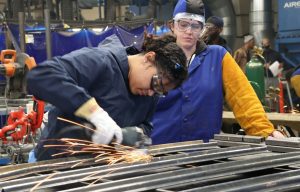
An idea on a napkin is a great start, but the workshop is where it becomes reality. This is the hands-on manufacturing stage, where skilled work is the heart of the entire process.
A CNC machine can follow a program with incredible precision. But what happens when the block of aluminum it’s cutting is slightly harder than the last batch? The machine doesn’t know the difference. It might power through, breaking a costly cutting tool or producing a part that’s slightly out of spec.
But a skilled machinist standing nearby? They’ll hear the subtle change in the machine’s whine. They might feel a different vibration through the floor. They see the color of the metal chip coming off the material and know something has changed. They’ll pause the program, adjust the cutting speed, and save the part—and the expensive cutting tool.
That isn’t programming; that’s judgment and craftsmanship.
Solving Problems Under Pressure
The real world is messy. Tools break, materials get delayed, and things go wrong. A robot’s response to a problem is to stop and report an error. It’s a dead end until a person intervenes.
But a human team? That’s where the magic happens. People huddle up, diagnose the root of the problem, and figure out a workaround to keep things moving.
This ability to adapt is a human superpower.
Imagine a giant hydraulic press starts leaking fluid. An automated system would likely shut down the entire production line for safety. The maintenance crew, however, gets to work. They quickly diagnose that a specific seal has failed. They know a permanent fix will take hours, but they also know how to create a temporary patch that will safely get them through the current run. They keep production going while ordering the right part for an overnight fix.
One approach costs a day of lost work; the other saves it. That’s the difference people make.
Getting the Product to the People
A perfectly crafted product sitting on a loading dock is still only halfway through its journey. Getting it from the factory into a customer’s hands is a massive part of production that runs on human communication, negotiation, and trust.
A blizzard shuts down a major highway in the Midwest, bringing shipping to a standstill. An AI system can instantly flag the problem on a map, showing a sea of red alerts. It can even suggest alternate routes. But the AI can’t pick up the phone.
A human logistics coordinator can see the problem and immediately start working their network. They call a different trucking company they have a good relationship with, negotiating a new pickup to bypass the storm. They then personally call the anxious customer, give them a real-time update, and manage their expectations. That’s relationship management, and it’s what keeps the supply chain from breaking down completely.
The Last Mile and the Final Touch
For many products, the final step is installation or service—the ultimate human touchpoint. This is where a blueprint meets the real world, and they don’t always line up perfectly.
Imagine a team of installers arriving to fit a beautiful set of custom kitchen cabinets. The digital blueprints they have are perfect. But when they get there, they discover the house’s main wall is slightly bowed—something that happens in construction all the time. No robot or automated system can solve this problem.
This is where skilled craftsmanship takes over. The lead installer will need to think on their feet, scribing the back of the cabinets to fit the curve of the wall perfectly, ensuring a seamless look. They solve the problem on-site, making sure the final product is not just installed, but installed right. That hands-on, creative problem-solving is what makes a customer happy and completes the production journey.
From the first spark of a creative idea, to the hands-on skill in the workshop, to the quick thinking on the road and at the final install—the entire story of production is powered by people.
Technology is making each of these steps more efficient, but it’s also making human skills more valuable than ever. It handles the boring, repetitive, and dangerous tasks, freeing you up to do what you do best: be a creative thinker, a master problem-solver, and a great teammate.
So when you think about a career in the world of making things, don’t just focus on the factory floor. Think about the entire process.
A future in production offers you a chance to be part of the whole story—to use your brain and your hands to bring incredible things to life. It’s a field waiting for the next generation of thinkers and doers.